
by Tiago Gusmão
Tiago Gusmão is an educator and researcher in Education at the University of São Paulo, Brazil. His research explores how young people from different socioeconomic contexts understand Good Work and purpose, with particular attention to moral education, significant relationships, social vulnerability, and inequality. A member of The Good Project Brasil, he works at the intersection of academic research and educational practice, with a focus on youth development and socioemotional education. His research has been presented internationally at the Association for Moral Education (AME), where he received the Best Poster Award in 2025.
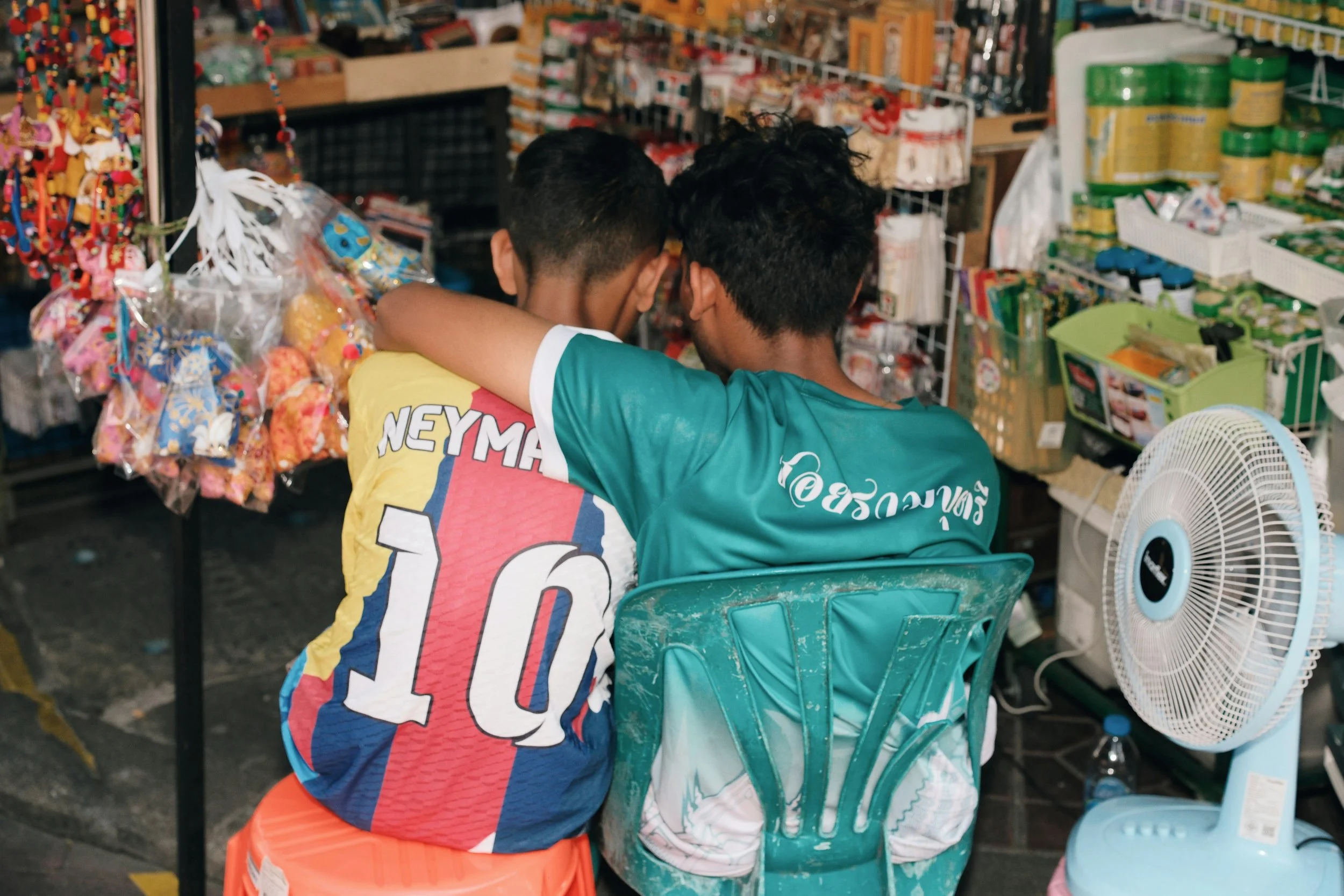
Two students can admire Neymar and admire entirely different things.
Neymar is a Brazilian soccer player known internationally for his career with Brazil’s national team and playing for clubs such as Barcelona and Paris Saint-Germain. When I asked 90 students in São Paulo, Brazil, “Who, in your opinion, performs Good Work?”, Neymar was the most frequently named public figure.
I must confess, it was not a surprise. However, when I looked closer the students’ explanations, I realized they were not describing the same person.
Some admired Neymar’s excellence, competitiveness, and ability to expand his career beyond soccer while others saw perseverance in a Neymar from a modest background who achieved success, supported his family, and used his position to contribute to others.
The reference figure was the same, but the reasons were entirely different. At that point, I realized that the more revealing question was not whom they chose but what they saw in that person. This shift in perspective guided the analysis that followed. Behind their choice, students constructed distinct moral portraits and expressed different conceptions of what it means to perform Good Work.
This inquiry was guided by a central question: “What do young people admire when they identify someone who performs Good Work, and what do their choices reveal about how their social worlds inform what they consider worth pursuing?”
To explore this question, I drew on the Good Work framework which describes Good Work as excellent in quality, ethical in its responsibilities to others, and engaging as a source of personal meaning (Gardner, 2025).
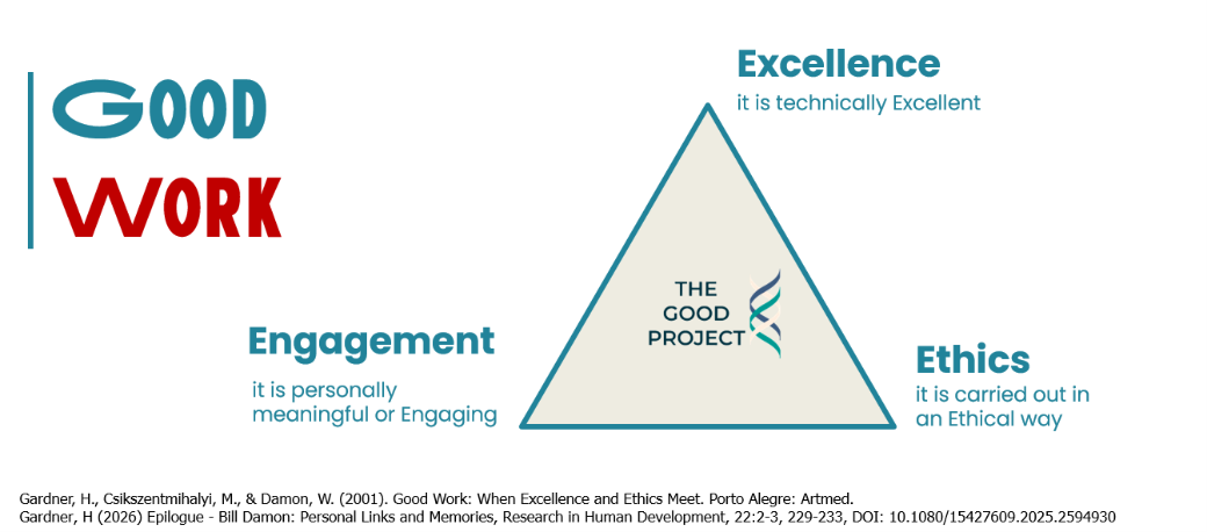
Figure 1. Excellence, Ethics, and Engagement as the three dimensions of the Good Work framework developed by Howard Gardner, Mihaly Csikszentmihalyi, and William Damon. Source — The Good Project.
The framework also informed the educational pathway. Through activities inspired by The Good Project, students reflected on their values, aspirations, moral choices, and people they considered examples of Good Work.
Two Schools, Two Social Contexts
The study involved 90 students at two schools in São Paulo. Sixty-nine students attended two senior-year classrooms at a school located near one of São Paulo’s largest informal settlements, where classes generally include around 35 students and the school operated with basic facilities and fewer technological resources. The other 21 students attended two senior-year classrooms at a private school in a gated community area, where classes had no more than 12 students and included access to laboratories and a broader range of extracurricular activities.
Despite these differences, both schools followed the same twelve-session educational pathway inspired by the Fundamental Lessons developed by The Good Project, facilitating my examination of how conceptions of Good Work varied across socioeconomic contexts.
One early activity invited students to reflect on their personal values. Each student received a list of 30 values and selected the four they considered most important.
The responses revealed a contrast that was clearer than I had expected. At the school with lower socioeconomic vulnerability, Independence was selected by 95.2 percent of students, followed by Success at 81 percent, Vision at 71.4 percent, and Power at 61.9 percent. At the school with higher socioeconomic vulnerability, Faith was selected by 82.6 percent, followed by Commitment at 79.7 percent, Courage at 62.3 percent, and Relationships at 46.4 percent.
Whereas students at the lower-vulnerability school emphasized autonomy and achievement, those at the higher-vulnerability school gave more prominence to belief, perseverance, and relationships, suggesting different moral orientations.
Although the values activity was not designed to lead into a study of reference figures, the contrast in the responses made me curious about who these young people regarded as examples of Good Work and why. This prompted the following activity, in which I asked each student, “Who, in your opinion, performs Good Work?”. They could select anyone they wish before explaining their choice.
Their responses fell into two broad types of reference figures. Close personal figures were people students knew through everyday relationships, including mothers, fathers, teachers, friends, relatives, school staff and community members. Public figures were people they knew mainly through the media and public life, such as athletes, digital influencers, and politicians.
Mothers were the most frequently mentioned figure overall, appearing in 23 responses, followed by Neymar in 15 and Virginia Fonseca, a Brazilian digital influencer, in 12. Teachers were mentioned in 11 responses, fathers in 8 and politicians in 8, and the remaining 13 students named a range of other personal and public figures.
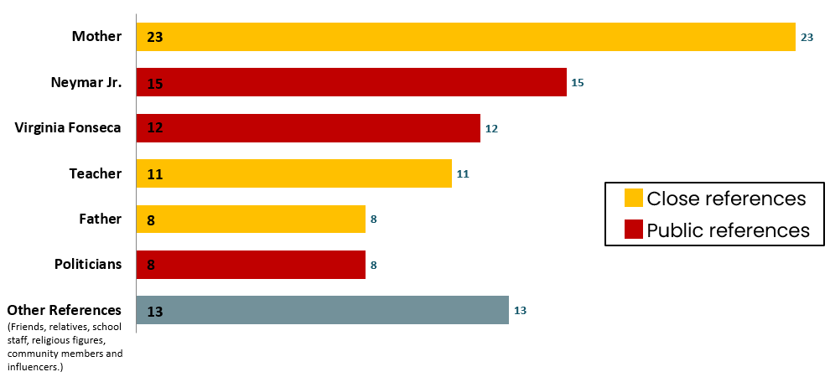
Figure 2. Reference figures identified by students as examples of Good Work (N = 90). Each student named one person. The less frequently cited figures were combined as Other References.
The prominence of close personal figures echoes a global study in which adolescents most often identified family members as Good Work role models (Clark et al., 2025).
How Meaning Is Constructed
To understand the meanings students constructed around the figures, I analyzed their explanations through the Theory of Organizing Models of Thinking, or OMT (Moreno Marimón et al., 1999).
OMT begins with the premise that people do not simply reproduce reality in their explanations but select certain elements, assign meanings to them, and establish relationships among those elements and meanings, which the theory calls implications. Rather than beginning with predefined categories, the organizing models emerge through repeated readings of how participants construct their responses.
To illustrate how this process works, consider the responses of two students who selected Neymar.
ID 78 - “I think I would choose Neymar. I like his story because he came from a very modest background and managed to help his entire family through soccer. He has a social project with children in Santos, and this shows courage and engagement.”
ID 86 - “In my opinion, Neymar performs Good Work because he took advantage of his success in soccer to do other things beyond the field. He is a player, a businessman, and works with brands, sponsorships, and investments. He was smart enough to turn his career into something bigger than playing soccer.”
Quotations translated from Portuguese.
Both students referred to the same public figure, but they constructed different interpretations of why Neymar performed Good Work. In the first response, his trajectory gained meaning through overcoming adversity, supporting others, and making a social contribution, while in the second it gained meaning through autonomy, strategic thinking, and career expansion.
This distinction became the research’s central finding because a reference figure, whether a public or someone close to the student, does not come with a fixed moral meaning. Instead, students actively construct meaning by selecting what matters to them in relation to their values, experiences, relationships, and social contexts.
Six Models of Good Work
Applying this approach across all 90 explanations, six organizing models of Good Work emerged. These models represented different ways of organizing what made someone worthy of consideration as Good Work.
M1 — Autonomy, Success, and Career Expansion. Good Work is understood as achieving independence and professional success while using an established career to create new opportunities.
M2 — Excellence, Competence, and Engagement. Good Work is understood as producing high-quality work through technical competence, dedication, and meaningful involvement.
M3 — Effort, Overcoming Adversity, and Life Change. Good Work is understood as persevering through difficult circumstances and using effort to transform one’s life.
M4 — Duty, Responsibility, and Integrity. Good Work is understood as fulfilling responsibilities, acting with integrity, and doing what is right even without recognition.
M5 — Care, Presence, and Support. Good Work is understood as being present in everyday relationships and offering care, emotional support, and direct help to others.
M6 — Collective Responsibility and Social Transformation. Good Work is understood as extending responsibility beyond individual relationships through community contribution and positive social change.
During the analytical process, shared orientations became visible among the six models. M1 and M2 emphasized autonomy, competence, and personal achievement, so I grouped them as achievement-oriented conceptions. M5 and M6 emphasized relationships, responsibility toward others, and contribution, forming a relational conception. M3 and M4 remained analytically distinct because they did not fit clearly within either grouping.
At the lower-vulnerability school, achievement-oriented models accounted for 62 percent of responses and relational models for 24 percent. At the higher-vulnerability school, this pattern shifted, with achievement-oriented models accounting for 29 percent of responses while relational reached 49 percent.
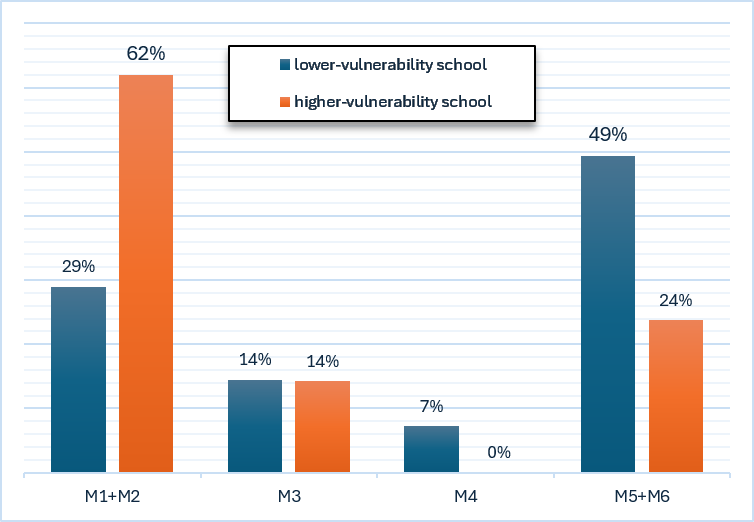
Figure 3. Distribution of achievement-oriented (M1+M2) and relational models (M5+M6) by socioeconomic context.
The two Neymar responses illustrate this contextual variation. The response centered on family support and social contribution reflected M6, which was proportionally more common in the higher-vulnerability context. The response centered on business opportunities and career expansion reflected M1, more prevalent at school with lower socioeconomic vulnerability. Both models appeared in both schools, but with different frequencies.
Taken together, the parallels between students’ value choices and their organizing models suggest that ideas about Good Work are embedded in broader moral and social orientations.
The distinction between types of figures added another layer to the findings. While close personal figures tended to concentrate within a narrower range of models, public figures appeared across a wider variety, reinforcing that choosing the same person did not necessarily mean holding the same conception of Good Work. Rather than residing in the figure itself, meaning emerged through the relationship between a reference figure and the student interpreting it.
Why This Matters for Education
For educators, the value of these findings begins with a simple shift from the person students choose to the reasons behind that choice. A name alone reveals little, but students’ explanations bring their values, aspirations, and ideas about Good Work into view, giving teachers a richer starting point for classroom conversation.
In Brazil, this matters because young people make sense of work within deeply unequal social realities. Research shows that their life purposes are closely tied to identity and collective values, especially when they involve overcoming economic hardship and pursuing financial achievement (Arantes & Pinheiro, 2021). In place of reading these differences as deficits or fixed limits, educators can ask what each context brings into focus about work, success, and responsibility.
At the same time, limited resources should not lead educators to expect less from young people. Youth from low-income communities are just as likely as middle-income youth to report lives of purpose (Bronk et al., 2020). When teachers recognize the aspirations and emerging purposes students already bring to school, they can help them clarify and expand the futures they imagine and the contributions they hope to make.
If we talk about purpose, another layer is added as it connects who young people are, what they hope to achieve, and how they might contribute to something beyond themselves (Damon, 2025). When students have openness to explain why a reference figure matters to them, they can put into words how their values might guide future choices and commitments, making their emerging purpose easier to discuss.
In the classroom, the Good Work framework can turn these choices into meaningful conversation. Simply approving or rejecting the reference figures students choose does not seem sufficient. Teachers can go further by asking how Excellence, Ethics, and Engagement appear in students’ explanations, comparing what different students see in the same person, and considering how the work they value affects others. In this way, reference figures become a bridge between personal ambition, quality, responsibility, and contribution. Perhaps asking young people who they admire is only the beginning. What they admire in the people they choose may tell us far more about the forms of Good Work, and the futures, they are beginning to imagine.
References
Arantes, V. A., & Pinheiro, V. P. G. (2021). Purposes in life of young Brazilians: Identities and values in context. Estudos de Psicologia (Campinas), 38, e200012. https://doi.org/10.1590/1982-0275202138e200012
Bronk, K. C., Mitchell, C., Hite, B., Mehoke, S., & Cheung, R. (2020). Purpose among youth from low-income backgrounds: A mixed methods investigation. Child Development, 91(6), e1231–e1248. https://doi.org/10.1111/cdev.13434
Clark, S., Mucinskas, D., Barendsen, L., McHugh, K., & Cantor, A. (2025). Global youth perspectives on “good work” role models: A qualitative study of character strengths and behaviors. Journal of Character Education, 21(1–2), 5–29. https://doi.org/10.1108/JCED-08-2025-0007
Damon, W. (2025). The psychology of purpose: A comprehensive approach. Review of General Psychology, 29(4), 395–406. https://doi.org/10.1177/10892680251324154
Gardner, H. (2025). Epilogue—Bill Damon: Personal links and memories. Research in Human Development, 22(2–3), 229–233. https://doi.org/10.1080/15427609.2025.2594930
Moreno Marimón, M., Sastre, G., Bovet, M., & Leal, A. (1999). Conhecimento e mudança: Os modelos organizadores na construção do conhecimento. Editora da Unicamp; Moderna.