Updating our Social Impact Buckets: Mechanisms of Change
Lynn Barendsen & Shelby Clark
February, 2026
Last year, we shared our “Four Buckets of Changemaking” framework with students from around the world at the GCI Summit. The conversation was engaged, thoughtful, and — as is often the case when students really lean into it — somewhat critical.
Students weren’t pushing back on the idea of changemaking. They were pushing back on the labels. One title in particular - “Crafting a New Culture”- generated consistent confusion.
Across groups, students raised essentially the same point: Aren’t all of these about creating culture change in some way?
The students were exactly right. Changemaking, essentially, is all about changing culture in different ways. However, their confusion came from the titles of our original buckets:
Ripples Into Reform
Change Through Charity
Rooting for a Reset
Crafting a New Culture
I admit, I was maybe being a bit whimsical when I created these first names. I wanted them to have alliteration so that they were easy to remember, rather than focusing more on their deep meaning. Testing them out at the Summit was the first “dry run” of them in practice with adolescents, and it was important to see how they failed. Conceptually, the distinctions worked. However, students struggled to differentiate the buckets in practice.
They argued:
Policy reform changes culture.
Philanthropy can change culture.
Social entrepreneurship can change culture.
Similarly, nearly every pathway to impact produces ripple effects. From a student perspective, the categories began to feel overlapping rather than distinct. But, these distinctions matter.
We originally came up with these buckets as the result of our “Investigating the Impacts of Educational Experiences” study, which ran from 2017-2022. In that research, we completed over 700 interviews with staff, students, and faculty at international secondary schools focused changemaking across the globe. In all these interviews, we asked “What does it mean to make a difference?” or “How do you make a difference?” The most prevalent answers included:
creating a cascade or ripple effect by spreading one’s values (21% of comments);
creating small or incremental changes (20% of comments);
using relationships and kindness/humanity to further change (19% of comments);
raising awareness of an issue (18% of comments); and
other (18% of comments).
In particular, we specifically asked about types of actions in our surveys with students and alumni. You can see the types of changemaking activities they reported here:
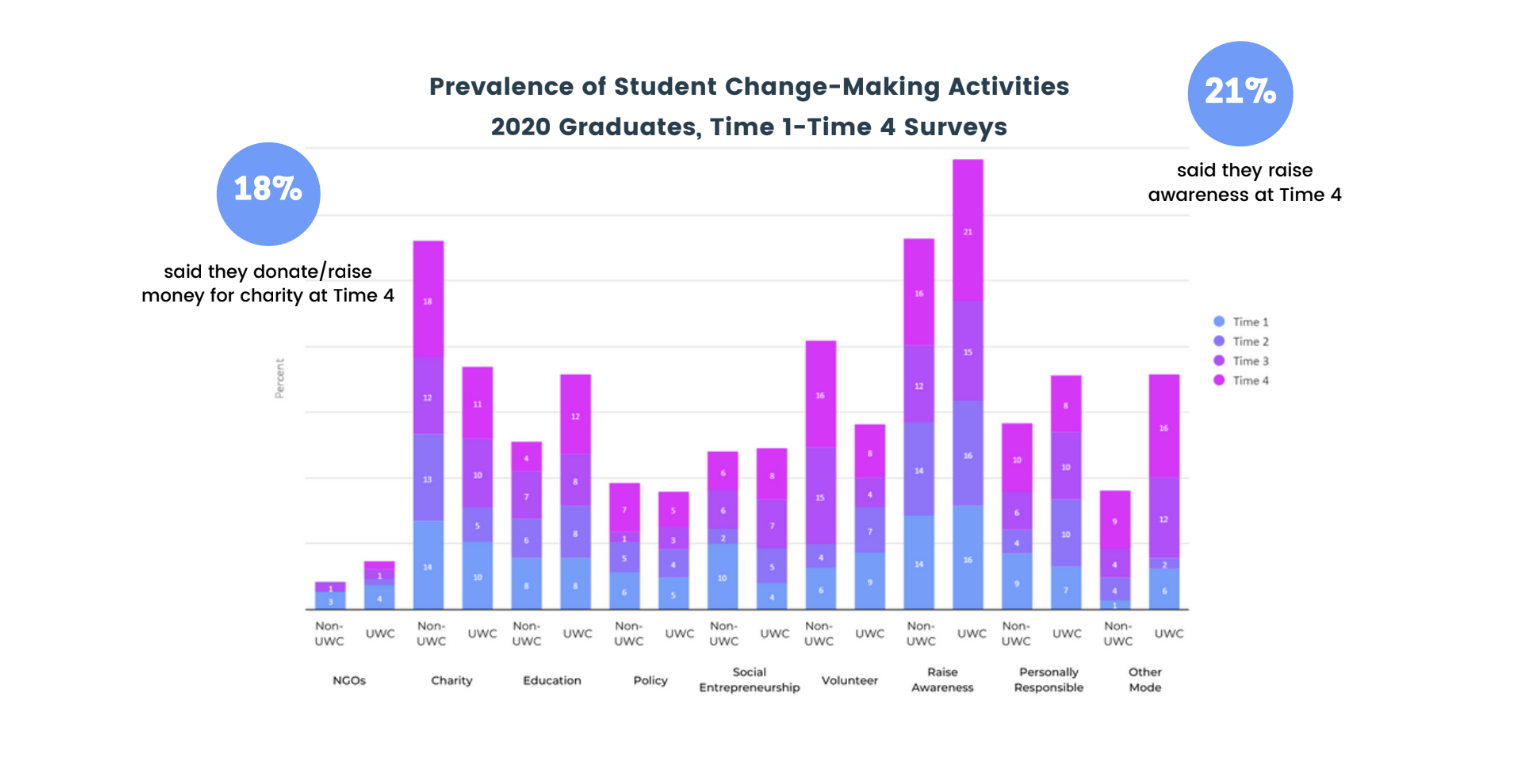
It was through the clustering of these various activities, along with the changemaking literature discussed in our previous blog What Does it Mean to Make a Difference? that we arrived on our initial four social impact buckets.
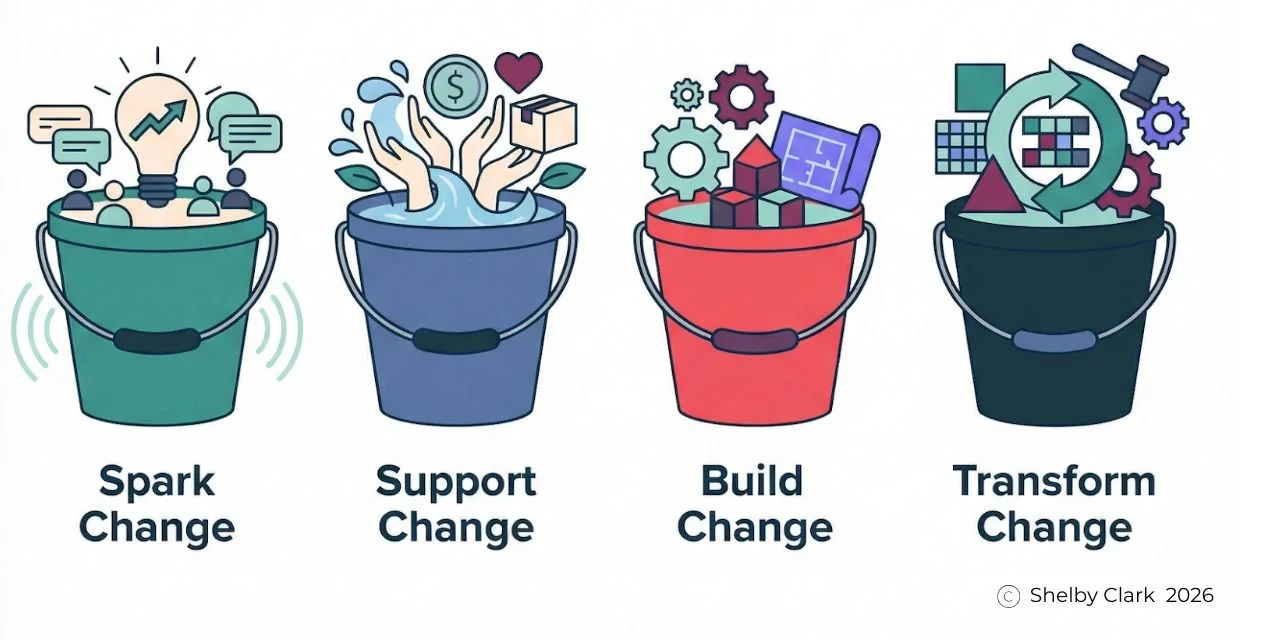
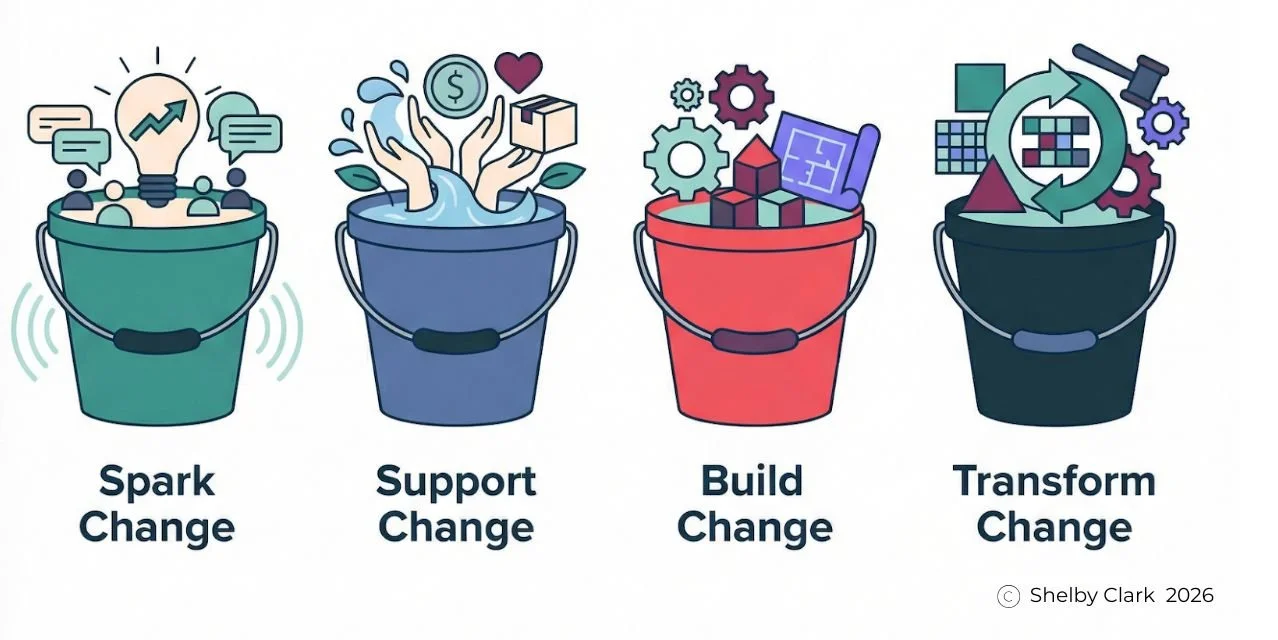
Now, in revisiting the framework, we’ve shifted away from these more whimsical, metaphorical titles and toward something more functional: mechanisms of change. That is, these revised buckets focus on the ways in which change operates. We’ll review them one by one here.
1. Spark Change
Mechanism: Influence
Spark Change involves influencing how people think, interpret, or respond.
Examples:
Conversations
Raising awareness
Role-modeling
Challenging assumptions
Kindness & inclusion
Symbolic acts
Key Clarifier: Sparking Change shapes understanding — it does not transfer resources.
2. Support Change
Mechanism: Provision
Support Change involves directly providing resources.
Examples:
Donating money
Providing goods
Volunteering time
Mutual aid
Fundraising
Offering services
Key Clarifier: Time counts as tangible because it functions as a transferred resource.
3. Build Change
Mechanism: Creation
Build Change introduces something new.
Examples:
Programs
Organizations
Social enterprises
Research initiatives
Products or tools
New models
Key Clarifier: Build Change adds something that did not previously exist.
4. Transform Change
Mechanism: Systems Redesign
Transform Change alters structures.
Examples:
Policy reform
Institutional change
Coalitions
Legal change
Governance shifts
Key Clarifier: Transform Change reshapes systems.
Hopefully, in this new system, students have clearer decision rules and simpler classification questions as they go about thinking about what type of change they want to make in the world.
Do they want to influence understanding? → Spark
Do they want to give their resources or time? → Support
Do they want to create something new? → Build
Do they want to change systems or structures? → Transform
This is not to suggest that these buckets operate in isolation. Creating something new often requires both resources and shifts in understanding, and efforts to transform systems typically involve elements of influence, provision, and creation. The purpose of the framework is simply to help students (and others) think more clearly about the primary mechanism they are relying on to make change happen.
Your Changemaking Quiz: Which Changemaking Mechanism Feels Most Natural to You?
For each question, choose the response that feels most like your instinctive reaction.
Try not to overthink — go with what genuinely feels natural.
1. When you encounter a problem, your first instinct is to
A. Talk about it with others
B. Help someone immediately
C. Come up with a solution
D. Ask why the system allows it
2. Impact feels most meaningful when you:
A. Shift perspectives
B. Provide tangible help
C. Create something new
D. Change structures or rules
3. You are most energized by:
A. Dialogue & ideas
B. Service & contribution
C. Innovation & design
D. Reform & systems thinking
4. When something feels unfair, you tend to:
A. Challenge people’s assumptions
B. Support those affected
C. Design alternatives
D. Advocate for structural change
5. You believe change happens primarily through:
A. Influence
B. Resources
C. Creation
D. Redesign
6. In group projects, you often find yourself:
A. Framing the conversation
B. Taking care of practical needs
C. Generating ideas
D. Questioning underlying systems
7. If you had unlimited resources, you would rather:
A. Run campaigns / raise awareness
B. Fund or support people directly
C. Launch initiatives
D. Change policies or institutions
8. Which feels most satisfying?
A. Changing how people think
B. Helping someone immediately
C. Building something new
D. Fixing root causes
9. When you see a gap or problem, you think:
A. “People need to understand this better.”
B. “Someone needs help right now.”
C. “Something new needs to exist.”
D. “The system needs to change.”
10. You are most drawn to activities that involve:
A. Communication / storytelling
B. Helping / assisting / serving
C. Designing / creating / inventing
D. Analyzing / reforming / restructuring
11. When you imagine making a difference, you picture yourself:
A. Influencing people
B. Supporting others
C. Creating solutions
D. Transforming systems
12. Which frustration sounds most like you?
A. “Why don’t people see this?”
B. “Why isn’t anyone helping?”
C. “Why hasn’t someone built this?”
D. “Why does the system work this way?”
13. Which strength feels most central to you?
A. Persuasion / communication
B. Generosity / responsiveness
C. Creativity / initiative
D. Critical thinking / systems thinking
14. If a friend wanted advice on creating impact, you’d most likely suggest:
A. Start conversations
B. Help directly
C. Build something
D. Push for reform
15. Which type of impact story resonates most with you?
A. Someone shifting public attitudes
B. Someone helping others directly
C. Someone launching something new
D. Someone changing laws or systems
Your Results:
Mostly As → Spark Change Orientation
You gravitate toward influencing understanding, norms, and perception.
Mostly Bs → Support Change Orientation
You focus on tangible contribution and direct assistance.
Mostly Cs → Build Change Orientation
You lean toward designing and creating new solutions.
Mostly Ds → Transform Change Orientation
You are drawn to structural change and root causes.
Remember, no bucket is better; no orientation is superior. Sustainable change requires all four mechanisms. The purpose of this framework is not to sort people, but to help students think more precisely about mechanisms and strategies.
A Note on the Earlier Framework
Our earlier blog, What Does it Mean to Make a Difference: Considering Four Frameworks, and quiz remain useful for reflection. This update simply reflects that frameworks should evolve with evidence and feedback.