Seeing the Whole: Aligning Good Work, Character, SEL, Practical Wisdom, and Flourishing
Shelby Clark
January 2026
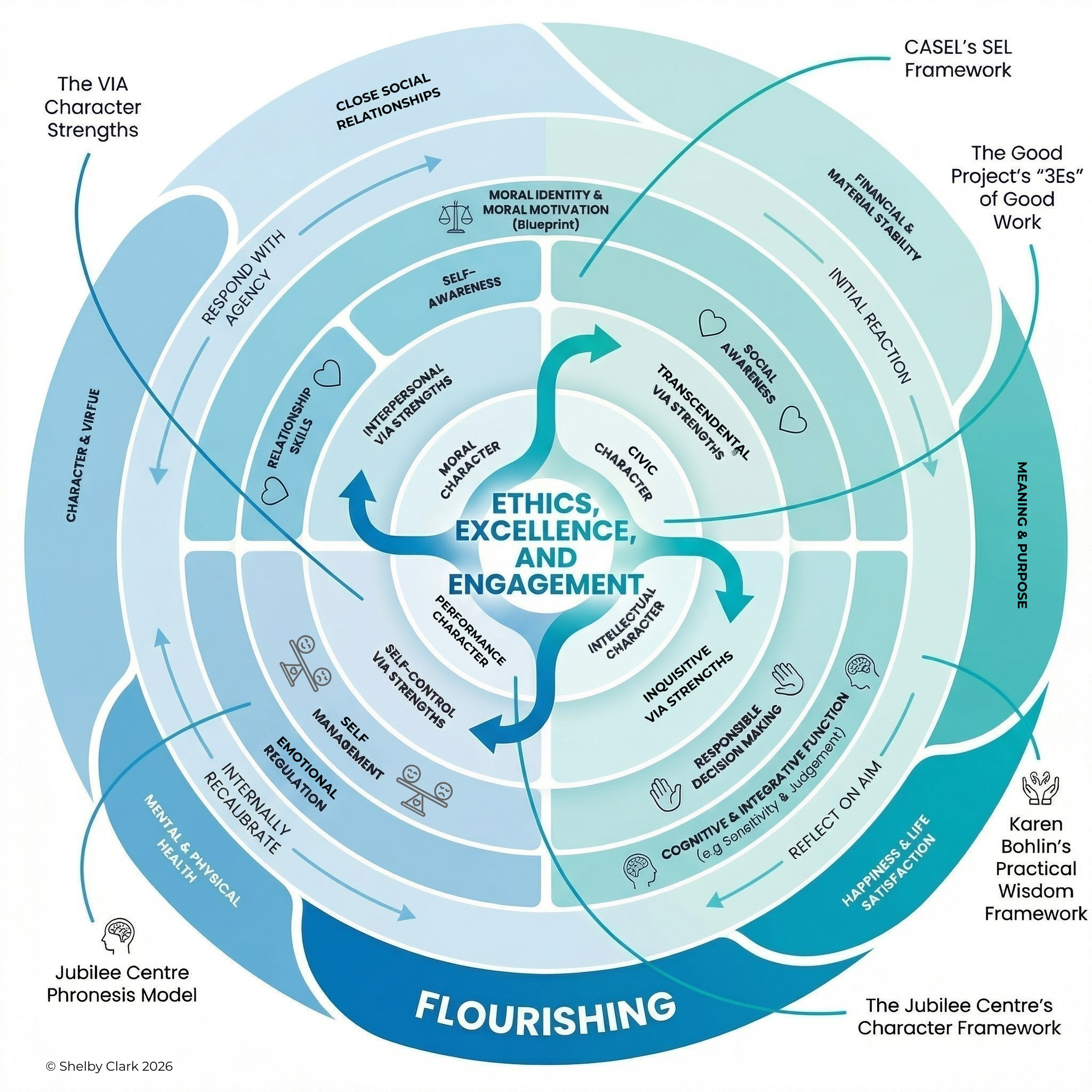
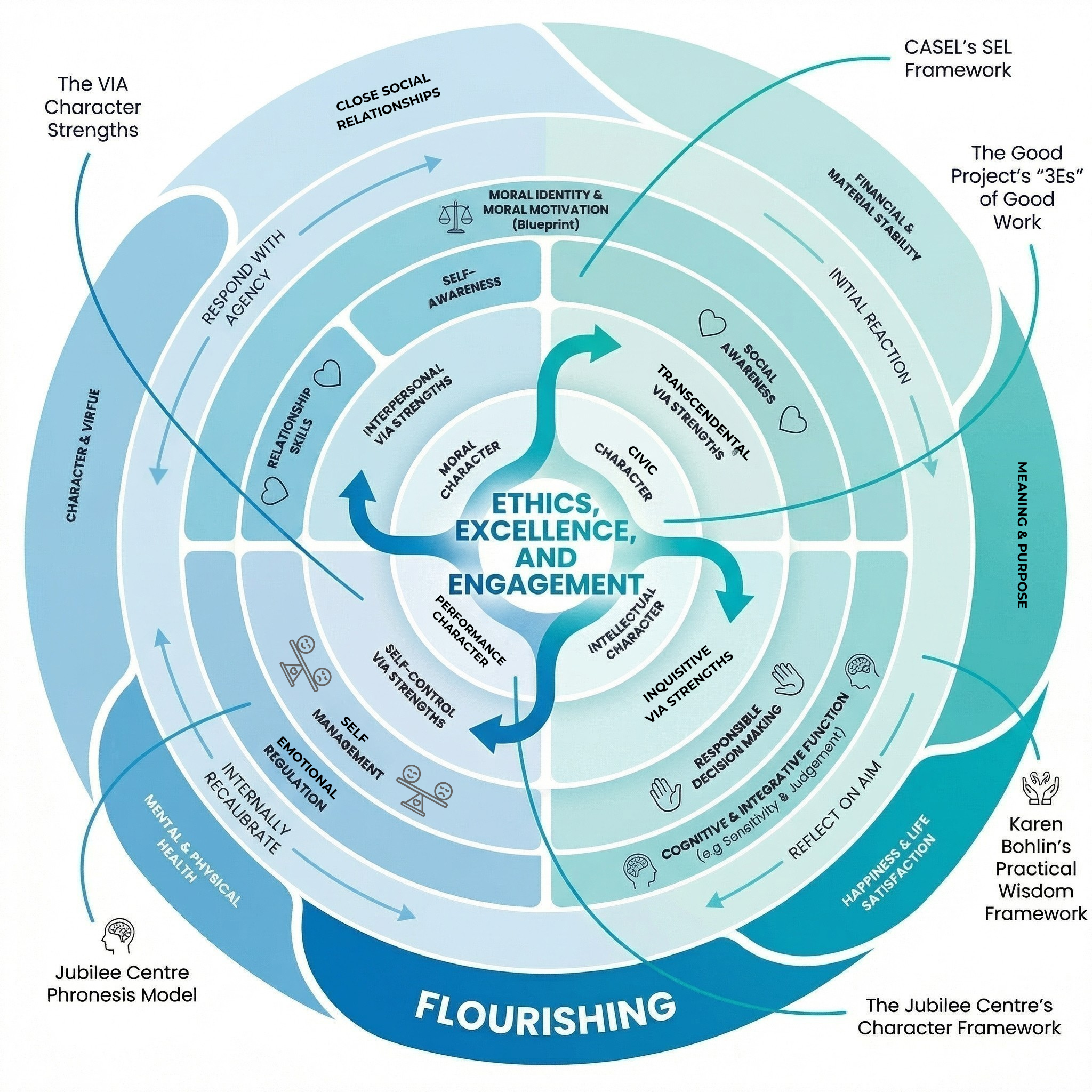
For a long time, I’ve been carrying around a mental image of how the many frameworks we use at The Good Project that draw upon character education, social-emotional learning (SEL), and human development might fit together. We often talk about “jingle-jangle” fallacies when talking about character strengths, “non-cognitive” strengths, social emotional learning skills, or thinking dispositions–the idea of using ”a single term to describe a multiplicity of quite different things.” Instead, I wanted to think about how these different types of ideas align with one another, rather than treating them as competitors. I finally tried to put that image on paper—and what emerged is the model above.
The original idea began as a well: a way of looking downward through layers of theory and practice to understand what ultimately supports people in doing good work and living well. As the thinking evolved, however, the image became less vertical and more dynamic. What you see now is not a ladder or a hierarchy, but an integrated system—one that shows how different frameworks overlap, reinforce one another, and work together over time.
At the center of this system are the Good Project’s 3Es: ethics, excellence, and engagement. Everything else in the model helps explain how people develop the capacity to enact those commitments in real, complex contexts.
The 3Es as the Organizing Core
The Good Project 3Es—Ethics, Excellence, and Engagement—have always been about what it means to do good work in the world: work that is responsible in its impact, high in quality, and meaningful to the person doing it.
In the model, the 3Es sit at the center because they are integrative. They don’t replace other frameworks; they help orient them. They raise the question: How do we support people in acting ethically, striving for quality, and remaining meaningfully engaged—especially when those aims come into tension?
Character as the Structure That Supports Action
Surrounding the 3Es are the forms of character emphasized by the Jubilee Centre for Character and Virtues Framework for Character Education: moral character (how to be a good neighbor), intellectual character (how to be a good thinker), civic character (how to be a good citizen), and performance character (how to do one’s work well). I appreciate this framework because it takes character seriously as a multi-dimensional construct and explicitly connects character to action.
Character, in this view, isn’t just about who someone is. It’s about knowing when to draw on character, being motivated by truth or virtuous aims, and having the skills needed to follow through in practice. These forms of character are the pathways through which ethics, excellence, and engagement are expressed in everyday decisions.
VIA Character Strengths as the Building Blocks
Woven through these character pathways are the VIA Institute on Character character strengths, which research has often shown to cluster into broader groupings (such as interpersonal, self-regulatory, inquisitive, and transcendent strengths) (McGrath & Walker, 2016; Partsch et al., 2022).
I think of VIA strengths as the building blocks of character—the psychological and behavioral ingredients people draw on in different contexts. Curiosity, perseverance, honesty, kindness, perspective: these are the raw materials that get shaped by educational contexts and cultures.
SEL as the Enabling Layer
The next layer outward brings in the CASEL SEL framework—self-awareness, self-management, social awareness, relationship skills, and responsible decision-making. SEL is sometimes positioned as separate from character education, but when I laid these frameworks on top of each other, the overlap was clear. Other groups, such as Character.org in their CSED national guidelines, have similarly examined this overlap.
SEL skills and capacities make it possible for character to show up under real conditions: when emotions run high, when relationships are strained, and when decisions carry social consequences. Without self-regulation, empathy, and reflection, even strong character commitments can break down.
Practical Wisdom: Where Everything Comes Together
What integrates all of these frameworks is phronesis (practical wisdom), drawing on both the Jubilee Centre’s phronesis model and Karen Bohlin’s work on practical wisdom. Practical wisdom is often described as a “meta-virtue”—the capacity to know what to do when you don’t know what to do (Bohlin, personal communication).
In the model, practical wisdom appears as movement and flow rather than a fixed layer. It involves deliberation, reflection, sensitivity to context, and responsiveness to norms and cues. This is where knowing, valuing, and doing converge—where character strengths, SEL skills, and the 3Es are brought into alignment in specific situations. Practical wisdom allows individuals to weigh competing goods, navigate moral tension, and decide when and how to draw on particular character strengths in context.
Flourishing as an Emergent Outcome
At the outer edge of the model is flourishing, drawing on the Harvard Human Flourishing Program’s framework. Flourishing is not treated here as a starting point or a discrete outcome to be taught. Instead, it is emergent, resulting from sustained ethical action, meaningful engagement, and excellence pursued with practical wisdom over time.
Flourishing includes purpose and meaning, close relationships, mental and physical health, stability, character and virtues, and life satisfaction. The arrows in the model reflect feedback loops: flourishing supports future engagement; strong relationships strengthen ethical action; meaning sustains effort.
Why This Model Matters
This model is not an attempt to collapse distinct frameworks into one or to suggest that they are interchangeable. Instead, it’s an attempt to show how they fit together without losing what makes each valuable.
When SEL, character education, practical wisdom, and flourishing are intentionally aligned, they stop competing for space and start reinforcing one another. What becomes possible is not just skill development, but wise action—and, ultimately, lives marked by purpose, integrity, and well-being.
This model is a thinking tool, not a finished theory. But it has helped me see the field more coherently—and I hope it offers others a way to see how our shared frameworks might work better together.
A Note on Interpretation and Orientation
Finally, it’s important to be clear about what this model is and what it is not. There are myriad ways to organize, interpret, and align character, SEL, practical wisdom, and flourishing frameworks. One could just as reasonably place SEL, character strengths, or flourishing at the center of this model, or emphasize different pathways through which these constructs reinforce one another. This model is not meant to be definitive or exhaustive.
I began creating this model with the Good Project’s 3Es—ethics, excellence, and engagement– at the center because they serve as The Good Project’s core interpretive framework. The 3Es shape the questions we ask, the tensions we attend to, and the kinds of outcomes we care most about, particularly in relation to work, learning, and civic life. Starting from the 3Es allows us to examine how character, SEL, and practical wisdom support people in navigating real dilemmas where values, responsibilities, and life roles are often in tension. As such, the model is best understood as an interpretive lens; not a map of the territory.
*Author’s note: This piece benefited from light editing and clarity suggestions generated with the assistance of ChatGPT. All ideas, interpretations, and conclusions are my own.