
By: Shelby Clark
I recently attended the Harvard Initiative for Teaching and Learning (HILT) conference on the “The Weight of the Degree: Rigor, Responsibility and the Modern Campus.” ur team has been trying to understand how and if colleges are preparing modern graduates to do “good work” in their futures (see the Good Work Values Alignment project). The overlap with the discussion at the conference struck me. What did I hear?
First, it’s important to understand the contemporary “good work” qualities that our project has identified and how they align with The Good Project’s traditional understanding of “good work” as the 3Es of ethics, excellence, and engagement.
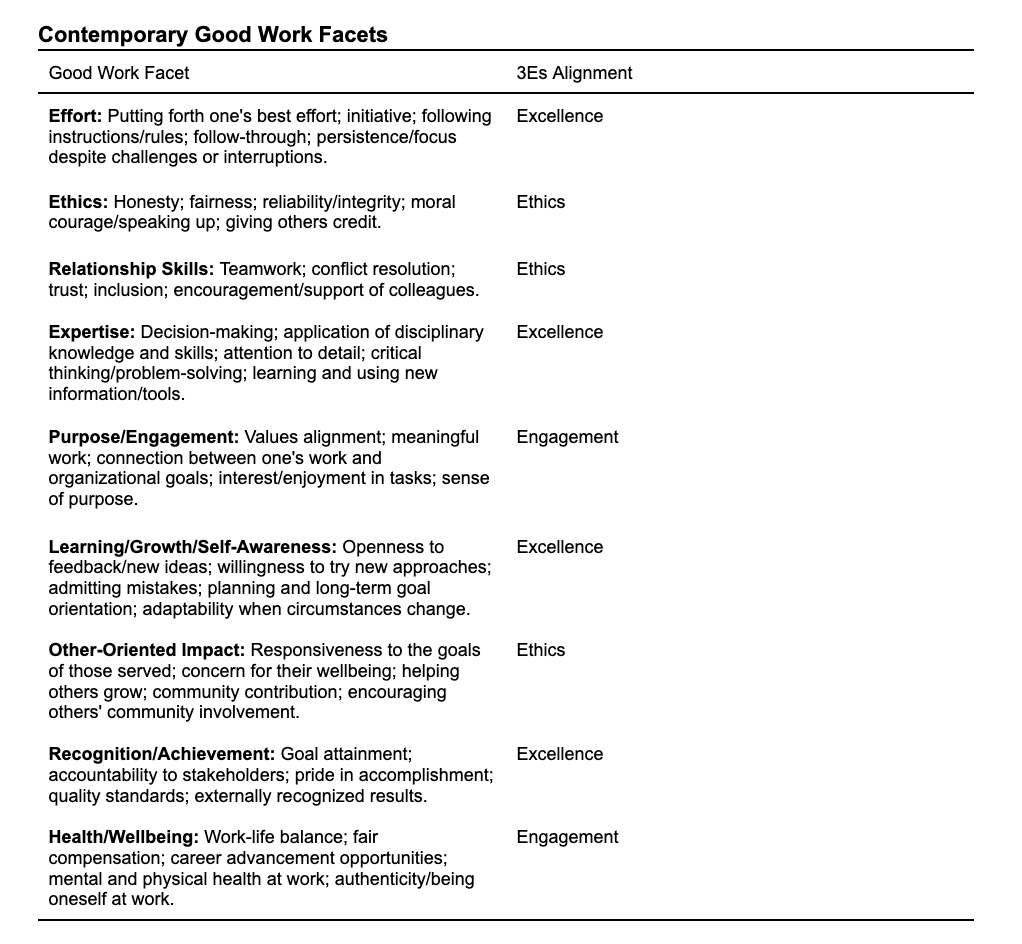
Our project found that students and employers both significantly report that all nine of these areas are important for doing good work. However, employers and students also reported a significant gap between how important they feel these qualities are and how much they think a college education is preparing students to embody these qualities. Read more about our findings here.
The HILT conference began with a keynote entitled “The Recentering of Academic Rigor in Service of Society: A One Harvard Perspective” with Dr. Amy Edmondson, the Novartis Professor of Leadership and Management at HBS, Dr. Rachel Weber, the Emma Bloomberg Professor of Urban Planning at GSD, and Dr. Le Xie, the Gordon McKay Professor of Electrical Engineering at SEAS. It was moderated by Dr. Bernard Chang, the Daniel D. Federman, M.D. Professor of Neurology and Medical Education at HMS. I was struck right away by the overlap with our fields of study: architecture and construction and the Graduate School of Design, healthcare and Harvard Medical School, IT and the School of Engineering and Applied Sciences. Would these distinguished professors see the same needs as our participants?
Certainly, all the keynote participants recognized the value of technical expertise. Dr. Weber noted that the degree must give students their technical foundation.
But what were the other qualities they mentioned as important for Harvard graduates? They included:
Ethical reflection,
Ongoing learning,
Interpersonal capacities,
Humility,
Emotional intelligence,
Analyze impact,
Actional judgment in the real world,
Flexibility,
Reflexivity about our histories and contexts,
The ability to get things done,
Translating knowledge to others,
Ability to defend the work and offer persuasive arguments,
A need to engage with the world,
The ability to turn challenges into opportunities,
How to think, not what to think,
Interprofessional skills,
Collaboration and teamwork skills,
Continuing to choose curiosity,
The ability to ask genuine questions of others,
Productive struggle and failure.
In particular, the presenters had quite a bit to say about the value of humility. Dr. Edmondson noted that humility involves “the capacity to choose curiosity in an ongoing way” and that it “shifts our interest towards others.” Dr. Weber agreed that “curiosity and humility” are important. Dr. Xie noted that we have to teach students to say when they don’t know how to solve a problem; he quipped of his own research, “I just don’t know how to solve the power grid problem!”
Clearly, we need to find a way for all students, undergraduate and graduate, across fields and domains, to develop these abilities to do good work. How can we do this? What pedagogy will help? Our own research participants focused on the need for real-world experiences: simulations, hackathons, internships, apprenticeships, and more. The keynote speakers had similar ideas. Key ideas were:
Judgment in real time: We need to teach students through real-world experiences where they need to make decisions. Students “need to engage with the world from the get-go.”
Cross-disciplinarity: Dr. Xie spoke about the new Energy, Climate, and the Environment concentration (ENCE) as one example of teaching students to work across disciplines.
A focus on societal needs: Presenters spoke about “technology for society,” thinking about what society asks for, thinking “Does your solution have the possibility of shaping society?” Dr. Chang agreed that education should be used to “shape students to be meaningfully responsive to what society needs.” Importantly, there was some discussion of whether liberal arts fields could fulfill this requirement, but presenters agreed that “all fields connect to students’ futures as citizens of society.” Dr. Weber noted, “some of the best graduate students are trained in philosophy–they know how to think.”
Updated evaluations: One presenter noted “the day of the take-home essay is gone.” Presenters encouraged in-class assessments, team-based assessments, bringing in external reviewers. Dr. Edmondson spoke about how she now uses shorter, in-person case studies in her class so that students need to answer on-the-spot. Dr. Weber agreed that students need to be able to justify their responses. However, Dr. Edmondson offered a reminder that “grades are an important part of rigor” because “grades are feedback.”
Utilizing AI: Dr. Weber spoke about how professors can use AI to simulate different environments, like a community hearing, and assign different roles. Students then have to respond on the spot in the simulation. Later “lightning round” sessions offered a plethora of examples of how to use AI in innovative educational ways, including:
The Harvard Business Impact Advisor, which is a conversational AI for course materials;
Using AI avatars as a low-stakes way to practice medical patient conversations;
AI tutoring via “TeachGPT” which can help teachers identify students misconceptions;
Collage AI, which designs and scaffolds an entire lesson using backward design and offers students immediate feedback;
LabXchange, that offers free online STEM materials; and
Mastering difficult conversations with AI voice chat.
6. Case-studies: Dr. Edmondson and Dr. Chang both noted that their respective schools use the case-study method. In particular, the presenters discussed how case-studies can be useful for fostering humility. Through cases, Dr. Edmondson said that students realize “I don’t want to be that guy.” Dr. Chang agreed, noting that case studies help students recognize where others fail.
7. Productive struggle: Overall, the presenters agreed that “learning has to be hard.” Dr. Weber spoke about how they use a flipped classroom that builds on what the students do at home so that they can struggle in collaborative settings. She noted, “if you don’t struggle, your ability to engage in classwork is impacted.” Dr. Edmondson agreed regarding the importance of productive struggle, noting that we have to “make students’ lives harder” and that we need to “reintroduce struggle.” Dr. Chang offered, “You wouldn’t send a robot to the gym to do your exercise for you.”
In our own work, we regularly use a version of case studies - ethical dilemmas - to help students consider their own values and decision making. We have just posted a number of new dilemmas inspired by our research in the GWVA study. Additionally, we firmly believe in the importance of "productive struggle" and have written extensively about how a culture that supports intellectual risk taking can support productive grappling with ideas. For more, see:
What do you think of these suggestions? Are you using them in your classroom? What other qualities do college graduates need to develop in order to do “good work” in the future?