
By: Shelby Clark and Lynn Barendsen
For decades, conversations about career readiness have centered on a familiar set of questions: Will graduates find jobs? Will they earn a good salary? Was college worth the cost? These are important questions. But they overlook something fundamental: good work.
What does it actually mean to do “good work”?
In their book, Good Work, Howard Gardner, Mihaly Csikszentmihalyi, and William Damon introduced a deceptively simple question: what does good work mean?
Their answer became the foundation of The Good Project, a decades-long research initiative at Harvard Project Zero.
Rather than defining success solely through achievement or income, The Good Project argued that truly good work brings together three essential qualities:
Excellence — work that is high quality and competently performed;
Ethics — work that is socially responsible and considers its impact on others; and
Engagement — work that is personally meaningful and fulfilling (Gardner et al., 2001).
Known as the Three Es of Good Work, this framework has shaped research, educational programs, and professional development initiatives around the world.
But the world of work has changed dramatically over the past two decades. Artificial intelligence is transforming nearly every profession. Employers increasingly emphasize durable skills alongside technical expertise. New forms of work, new educational pathways, and changing expectations about wellbeing, purpose, and belonging have reshaped conversations about career readiness.
These changes led us to ask:
How do today's students and employers understand good work?
Our latest study builds directly on The Good Project's original framework by examining how the concept of good work is understood in today's workforce—and whether those understandings have evolved.
Building on the 3Es
The Three Es remain the conceptual foundation of this work.
Rather than replacing Excellence, Ethics, and Engagement, we asked a different question:
If we were to describe these ideas in the language of today's students and employers, what would they look like?
To answer that question, we returned to the Good Project's own research archive.
Across more than a decade of studies—including student essays, interviews, focus groups, educator research, and pilot workforce studies—we synthesized more than 860 qualitative codes describing what people believed good work looked like in practice.
From those data, nine interconnected dimensions emerged.
These dimensions represent contemporary expressions of the Three Es—not replacements for them.
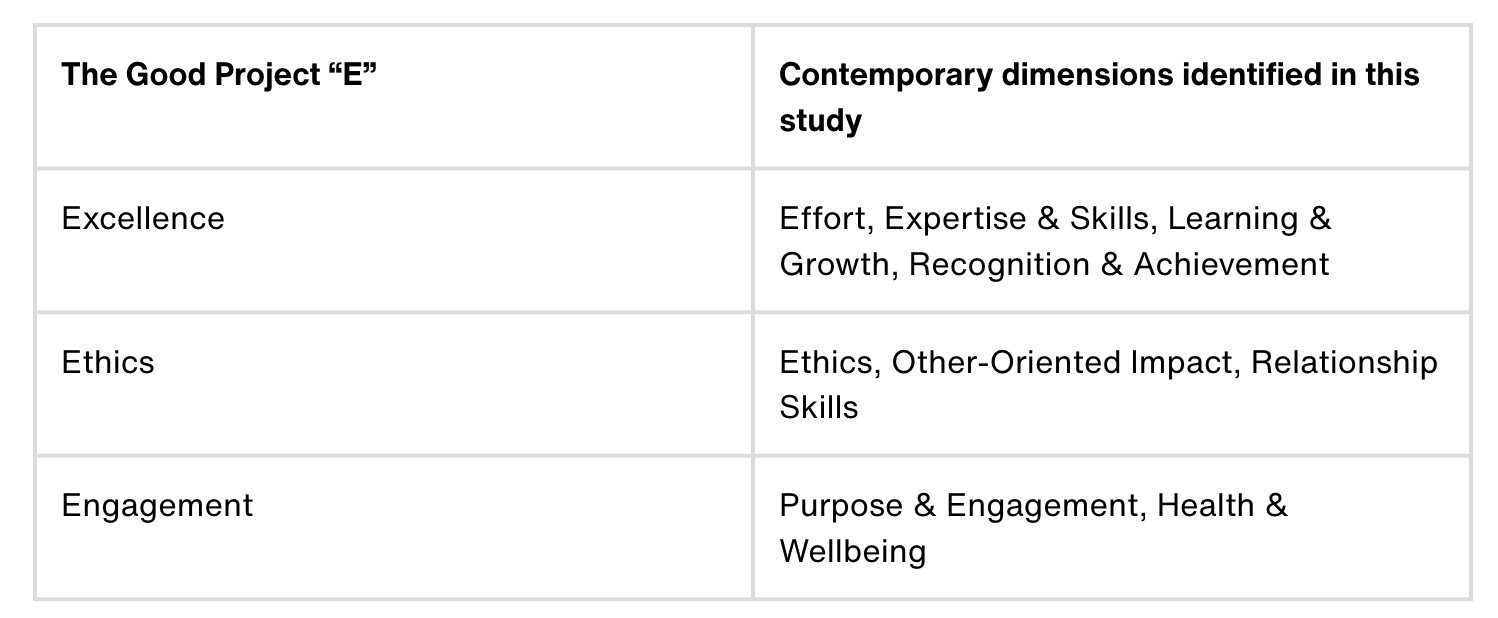
While each dimension stands on its own, together they provide a more detailed picture of how people think about good work in today's workplace.
For example, "Excellence" is no longer understood simply as producing high-quality work. Participants also emphasized persistence, continuous learning, adaptability, and striving for improvement. Likewise, "Engagement" encompassed not only finding meaning in one's work, but also sustaining one's wellbeing in order to contribute effectively over time.
What we found
One of the most encouraging findings was not how much employers and students disagreed—but how much they agreed.
Across healthcare, information technology, and architecture/construction, participants consistently described good work as involving much more than technical competence.
They valued persistence, ethical decision-making, collaboration, continuous learning, purpose, community contribution, and wellbeing alongside technical expertise.
Perhaps most notably, Effort emerged as the most consistently understood dimension across every industry and across both employers and students. This suggests that, despite rapid technological and economic change, people continue to share a common understanding that sustained effort and perseverance remain central to doing good work.
These findings suggest that the original vision of the Three Es remains remarkably relevant. At the same time, they offer a more detailed roadmap for what Excellence, Ethics, and Engagement look like in contemporary workplaces.
Why this matters
Much of today's conversation about workforce readiness focuses on whether graduates possess the right technical skills.
Our findings suggest a broader perspective.
Preparing people for good work means preparing them not only to perform tasks competently, but also to collaborate effectively, act ethically, continue learning, contribute to others, and find meaning in what they do.
In many ways, this study extends a conversation that began more than thirty years ago.
The Good Project asked, What is good work?
Our study asks:
What does good work look like today—and how can higher education help prepare people to do it?